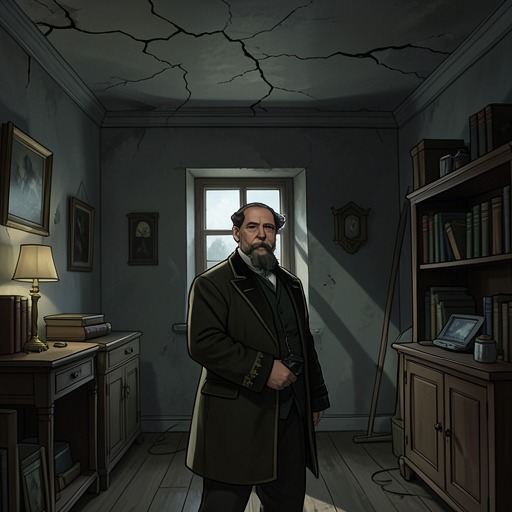
The haunted-house motif
The Hidden StaircaseThe haunted-house motif makes The Mansion seem to resist ordinary explanation, then converts that uncertainty into clues in Nancy Drew’s investigation. Sounds, shadows, music, a nighttime cry, and disappearing possessions threaten the sisters’ sense of safety and put their attachment to their home under pressure. The mystery’s decisive turn is not a supernatural revelation but Nancy’s recognition that a person has been using the house’s apparent haunting to frighten its residents and steal from them.
The House as a Source of Unease
Rosemary Turnbull introduces the problem as the experience of living in a haunted house, but immediately qualifies the description: she does not believe in ghosts, even though events have begun to unsettle her. That hesitation establishes the motif’s central tension. The supernatural explanation is available as a way to name what the sisters cannot account for, yet Rosemary remains reluctant to accept it as fact.
The setting gives that uncertainty a particular weight. The Mansion is an old family home, built before the Civil War, and Rosemary says that she and her twin sister Floretta Turnbull have lived there for thirty years without disturbance. The unexplained activity is recent, concentrated in the last few weeks. Its arrival interrupts a long period of ordinary occupation, making the house’s familiar history a contrast to its newly troubling behavior.
The disturbances are not confined to a single hidden corner. The sisters hear noises in different parts of the house, despite having inspected it and taking care to keep doors and windows closed. Shadows appear on the walls; Floretta thinks she has seen a human shadow and begins to suspect a ghost. The range of the sounds makes the whole house seem implicated, while the inspection and closed openings sharpen the question of how anything—or anyone—could be moving through it.
Escalation and Pressure on the Sisters
The motif gains force through different kinds of disturbance rather than one repeated effect. Rosemary reports hearing someone play a stringed instrument one night. The unexplained music increases her anxiety, while Floretta’s distress has become serious enough that she does not want Rosemary to leave her alone, even for a few hours. She urges Rosemary to agree to sell the house. Thus the apparent haunting does more than frighten the sisters: it threatens to separate them from a place they have occupied for decades.
Their responses are not identical. Floretta is increasingly prepared to interpret the events as the work of a ghost; Rosemary remains skeptical, though she admits that the events are getting on her nerves. The difference sustains uncertainty without making either sister’s reaction incidental. Fear has practical consequences for both, but it is Floretta’s wish to sell that gives the disturbances a clear material stake: if the sisters leave, the house may pass to someone else.
Later, missing objects make the pattern more concrete. Floretta recalls a sequence of losses—a spoon, a pocketbook, a pin, and finally the silver urn—which intensifies her conviction that a ghost is responsible. Nancy answers the apparent mystery with a physical detail: a chair has been pushed against the bookcase from which the urn was taken. The chair does not by itself explain how an intruder entered, but it changes the emphasis from an invisible presence to a person reaching for a particular object. The motif’s eerie effects and the thefts now belong to the same investigation.
From Apparition to Intruder
The haunting atmosphere also reaches beyond the house. Nancy receives an unsigned warning advising her to keep away from the Turnbull house; its bold handwriting seems to her likely to be a man’s. The message turns the mystery into a direct threat against the person investigating it, while offering no explanation for the disturbances. It therefore extends the sense of danger without confirming a supernatural cause.
A nighttime incident adds another sharp but unresolved alarm: Nancy hears a dull thud from below and then a yell before silence follows. In the context of the other disturbances, this moment intensifies the possibility that someone is present in or near the house. The account does not identify the cause of that particular sound at the moment it occurs; its function is to make the danger seem immediate while leaving the underlying explanation unsettled.
Nancy’s own interpretation moves in the opposite direction from the sisters’ fear. After leaving The Mansion, she thinks of it as haunted by a flesh-and-blood figure and plans to investigate if her father permits her to stay there for several days. Her suspicion is not yet proof. She believes that the disturbances have a human source, but recognizes that a theory alone is not enough to take a case to the authorities.
Exposure and Significance
After gathering information from different sources, Nancy concludes that Nathan Gombet has been visiting The Mansion and stealing the sisters’ valuables. She has already learned that he wants to buy the property for a very low price; this gives the apparent haunting a material context, since frightening the sisters could help drive them from their home. The evidence transforms the motif retrospectively: the noises, shadows, music, and losses no longer point toward a ghost but form part of a campaign by a human intruder.
The story also connects the mystery to an old passage between Gombet’s house and the Turnbull residence. Nancy imagines that the tunnel may have been built before the Civil War, when the two families were friendly, and then closed and forgotten after the brothers became enemies. The explanation locates the apparent impossibility of entry in the house’s history: a concealed route, no longer remembered by its descendants, can make repeated visits seem inexplicable without requiring anything supernatural.
The motif therefore works both as atmosphere and as misdirection. The old house, its unexplained activity, and the sisters’ differing degrees of belief create a credible interval of uncertainty; the sequence of stolen objects and the chair by the bookcase begin to give that uncertainty physical edges. When Nancy identifies Gombet as the culprit, the apparent haunting resolves into a human plot linked to theft and the prospect of acquiring the property cheaply. What seemed like an unseen presence is revealed as a concealed route and a deliberate effort to make the residents afraid.